A Benchmark Built Around Real Ownership
Calling any yacht the best in its class invites an obvious question: best for whom? A performance sailor may favor lighter construction and daggerboards. A charter operator may prioritize maximum berths, while an ocean voyager might accept less living space in exchange for greater payload and simpler systems.
The Lagoon 42 makes its strongest case by balancing the needs that matter to the largest number of cruising owners. It offers substantial accommodations without moving into the cost, complexity, and marina constraints of a much larger catamaran. It can be handled by a couple, configured for private ownership or charter, and sailed comfortably without requiring a racing crew.
That balance has been validated on an unusual scale. Introduced in 2016 after an initial production launch in 2015, the model reached its 1,000th completed hull in 2023. Lagoon subsequently developed the Lagoon 42 Millenium, keeping the platform in its current range rather than retiring one of its most successful designs.
Production volume alone does not make a boat superior. In the Lagoon 42’s case, however, it supports an ownership proposition that few direct competitors can match: a familiar design, a large knowledge base, established service channels, plentiful comparable boats, and equipment that marine professionals have encountered before.
A Big-Boat Experience Without the Biggest-Boat Burden
The Lagoon 42’s defining achievement is how large it feels without becoming unreasonable for an experienced cruising couple. Its hull length is 12.79 meters, while the current model’s overall length is 13.22 meters. Beam is 7.68 meters, providing the width required for a genuinely useful bridgedeck living area and generous cabins below.
Those dimensions create a clear step up from entry-level cruising cats. The aft cockpit has room for a proper dining table, circulation routes, and protected seating beneath the coachroof. Open the saloon door and the cockpit connects naturally with the galley and main living space. The result is the indoor-outdoor arrangement that attracts many sailors to catamarans in the first place.
This layout works especially well at anchor, where cruising boats spend most of their time. Meals can move easily between the galley and cockpit. Guests do not have to climb over one another to change seats, and the crew can enjoy shelter without feeling enclosed. Vertical and near-vertical glazing provides broad views while reducing some of the solar exposure associated with heavily raked saloon windows.
Owners choosing the three-cabin arrangement gain the starboard hull as a private suite, typically with a large aft berth, storage, a desk or dressing area, and a spacious head compartment. Four-cabin versions devote more of the boat to guest capacity and remain common in charter fleets. Neither arrangement feels improvised; each reflects a specific style of ownership.
Sailing Systems a Couple Can Actually Use
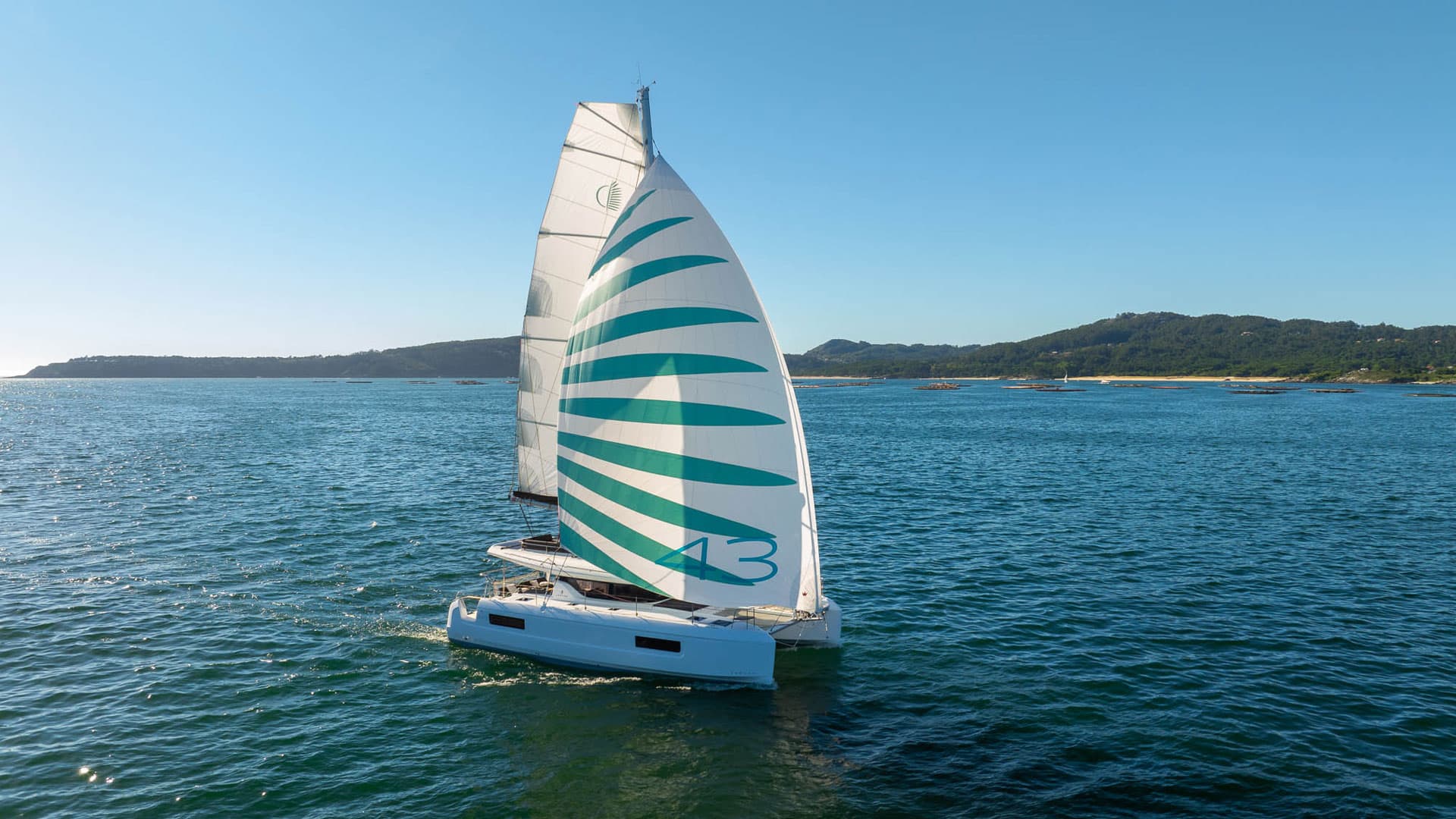
The Lagoon 42 was designed by VPLP, with exterior styling by Patrick le Quément and interiors by Nauta Design. Its most important technical feature is the aft-set mast, an arrangement that opens the foretriangle, permits a self-tacking jib, and reduces the size of the mainsail relative to a more conventional rig.
That matters because sail handling is not judged from a brochure. It is judged during a squall, an awkward reef, or a short-handed tack near traffic. With the working lines led to the raised helm and the jib crossing automatically, routine maneuvers require less movement around the deck. An electric winch, when fitted, further reduces the physical effort involved in raising and reefing the mainsail.
The helm is positioned above the port side of the cockpit rather than isolated on a full flybridge. This gives the driver useful sightlines and keeps communication open with people below. It also preserves more of the coachroof for solar panels and avoids placing an entire social area high above the boat’s center of gravity.
There are compromises. The helm remains exposed compared with an enclosed interior station, and some owners modify the seat, weather protection, or handholds. Access between the cockpit and helm deserves careful evaluation during a sea trial, particularly by buyers planning offshore passages. Even so, the arrangement is an effective middle ground between visibility, sail control, and social connection.
Performance That Suits the Mission
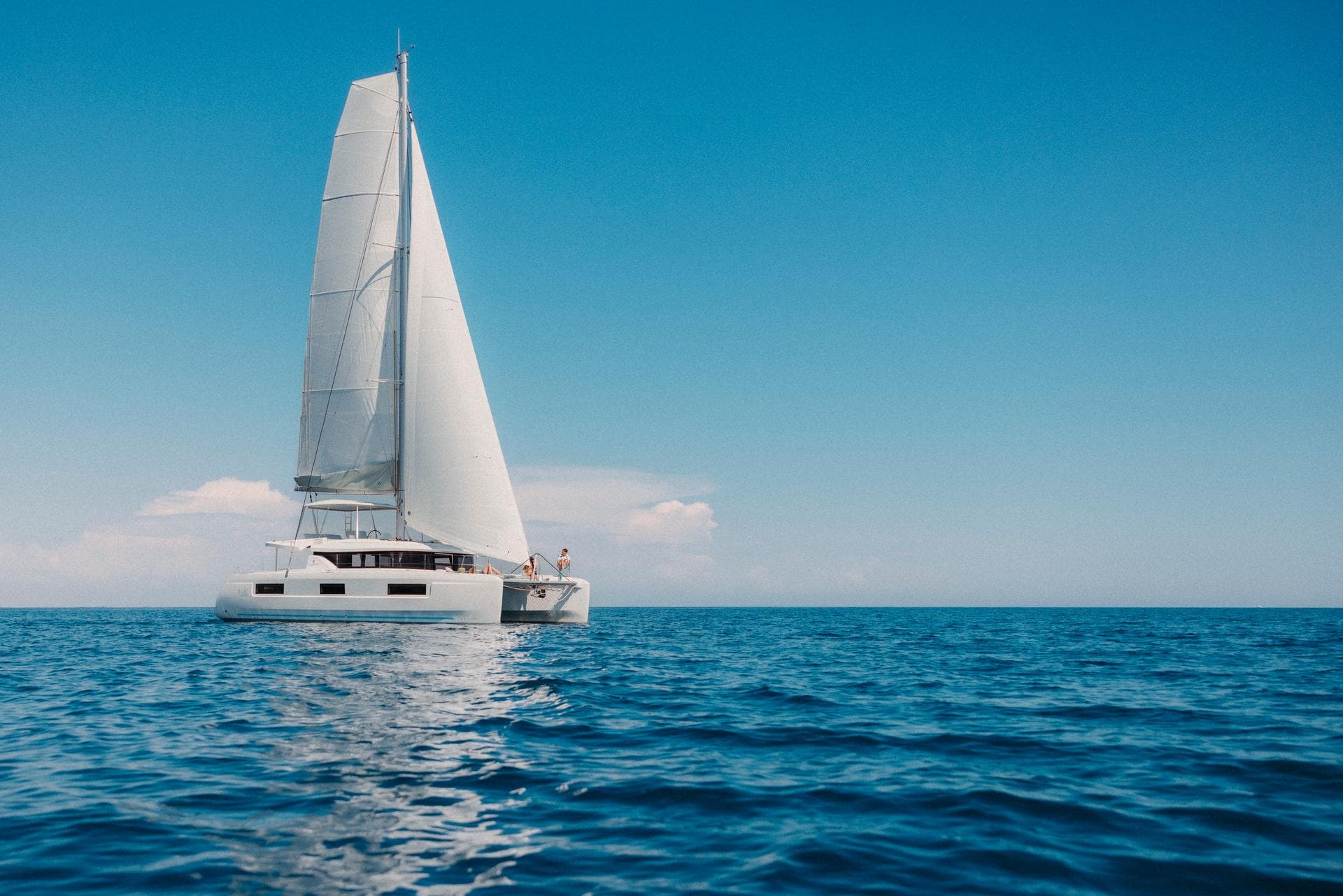
The Lagoon 42 is not a performance catamaran, and presenting it as one would miss the point. Its priorities include volume, load-carrying practicality, forgiving behavior, and comfortable life aboard. A lighter cat with narrower hulls and more sail area should accelerate sooner and point higher.
What distinguishes the Lagoon is that it sails respectably despite the accommodation it carries. Independent tests have recorded smooth tacking in light conditions and useful speeds under the standard working sails. The boat generally responds better when sailed slightly free rather than pinched hard against the wind, which is typical of cruising catamarans with fixed keels.
A Code 0 or comparable light-air reaching sail significantly expands its useful sailing range. The self-tacking jib makes everyday sailing easy, but its modest area cannot provide all the power needed when the wind fades or moves aft. Owners who expect to sail rather than motor through light conditions should treat the additional reaching sail as part of the cruising inventory, not as a decorative option.
Under power, widely separated twin engines provide the low-speed control that makes a catamaran manageable in a marina. The ability to use one engine ahead and the other astern allows the boat to pivot within its own length when conditions permit. Windage remains substantial, so practice and conservative docking plans are still essential.
A Layout That Continues to Work at Sea
Many catamarans impress during a boat-show walkthrough. Fewer remain convincing after provisions, tools, safety equipment, spare parts, a tender, and personal belongings arrive. The Lagoon 42 succeeds because its basic circulation remains straightforward after the boat is occupied.
The galley sits close to the cockpit and within the saloon rather than hidden in a hull. The cook remains connected with the crew and has immediate access to the dining areas. The central compression post also offers a useful handhold in a space that otherwise feels residential.
Wide transom steps simplify boarding from a dock or dinghy, while the aft cockpit gives the crew a protected transition area before entering the saloon. Cabins benefit from natural light, usable berth dimensions, and standing room that makes extended cruising more civilized.
Nevertheless, owners must resist the temptation to fill every locker simply because space is available. The Lagoon 42 has a published CE displacement of approximately 12.1 metric tons, but cruising additions can accumulate quickly. Batteries, solar equipment, a generator, watermaker, larger ground tackle, tools, spares, and recreational equipment all affect sailing behavior and bridge-deck clearance. Careful weight management is essential on any cruising catamaran, including this one.
The Advantage of a Thousand-Boat Fleet
High production numbers provide practical benefits long after delivery. Surveyors, riggers, sailmakers, charter technicians, and service yards are more likely to recognize the model and understand its systems. Owners can compare modifications with a large community rather than solving every problem in isolation.
Lagoon’s dealer and service network can also identify parts using a boat’s hull identification number. That does not guarantee that every component will be inexpensive or immediately available, but it provides a clearer support route than owners may find with a low-volume or discontinued builder.
The fleet’s size also gives buyers choices. The market includes earlier privately owned boats, heavily equipped liveaboards, former charter yachts, and newer Millenium versions. A buyer can prioritize condition, layout, equipment, location, tax status, or price rather than waiting for one rare example to appear.
Ex-charter boats should not be rejected automatically, but they require disciplined inspection. Higher engine hours, cosmetic wear, tired upholstery, repeatedly operated doors, and hard-used domestic systems are normal considerations. A documented maintenance history can be more valuable than a polished presentation covering years of deferred work.
What Prospective Owners Must Check
No production yacht should be purchased on reputation alone. A Lagoon 42 survey should include the rig, steering, engines, saildrives, electrical installation, plumbing, deck hardware, hull moisture, escape hatches, and evidence of grounding or collision. The surveyor should be familiar with composite multihulls and should inspect the boat both afloat and hauled.
Some Lagoon catamarans built through 2019 were equipped with fixed GOIOT emergency escape hatches covered by a manufacturer-supported recall campaign. Buyers should use the hull identification number to determine whether a particular boat is affected and obtain documentation showing that the prescribed safety work was completed.
Specifications must also be checked by build year. Earlier Lagoon 42s were commonly offered with 45-hp engines as standard and 57-hp units as an option, while the current Lagoon 42 Millenium lists twin 57-hp engines as standard. Current published fuel capacity is 570 liters, whereas earlier specifications commonly listed 300 liters. Equipment packages, tankage, sail area, and cabin details should therefore be confirmed on the individual yacht rather than assumed from a current brochure.
Why the Balance Still Wins
The Lagoon 42 is not the fastest 42-foot catamaran, the least expensive, or the most specialized offshore platform. Its claim to class leadership comes from being exceptionally complete. It gives couples and families the space they want, sailing controls they can realistically manage, twin-engine maneuverability, flexible accommodations, and support reinforced by more than 1,000 sisterships.
Most important, its strengths appear in daily ownership rather than only in headline specifications. The cockpit works for meals, the galley works with the social spaces, the cabins provide privacy, and the sail plan rewards owners who choose the right inventory. Its shortcomings are identifiable and manageable rather than hidden behind an extreme design brief.
For buyers seeking a production cruising catamaran that can serve as a vacation platform, full-time home, charter asset, or long-range family cruiser, the Lagoon 42 remains the standard against which the class is measured. It may not win every individual category, but few competitors assemble the complete ownership package so convincingly.