A Modern Cruising Benchmark
Calling any yacht amazing invites skepticism, but the Lagoon 42 has a stronger case than most. Since entering production in 2015 and making its public debut at boot Düsseldorf in 2016, this VPLP-designed catamaran has become one of Lagoon’s highest-volume cruising models. Lagoon celebrated the completion of its 1,000th Lagoon 42 in November 2023, an unusually significant production milestone for a boat of this size and complexity. The model remains in Lagoon’s range as the four-cabin Lagoon 42 Millenium. ()
Popularity alone does not make a boat good. In the Lagoon 42’s case, however, it reflects a well-judged combination of living space, manageable systems, useful sailing ability, and broad appeal. It is neither a stripped-out performance catamaran nor a floating apartment that treats sailing as an afterthought. Instead, it occupies the practical middle ground sought by many cruising families and charter sailors.
A Size That Opens Up Possibilities
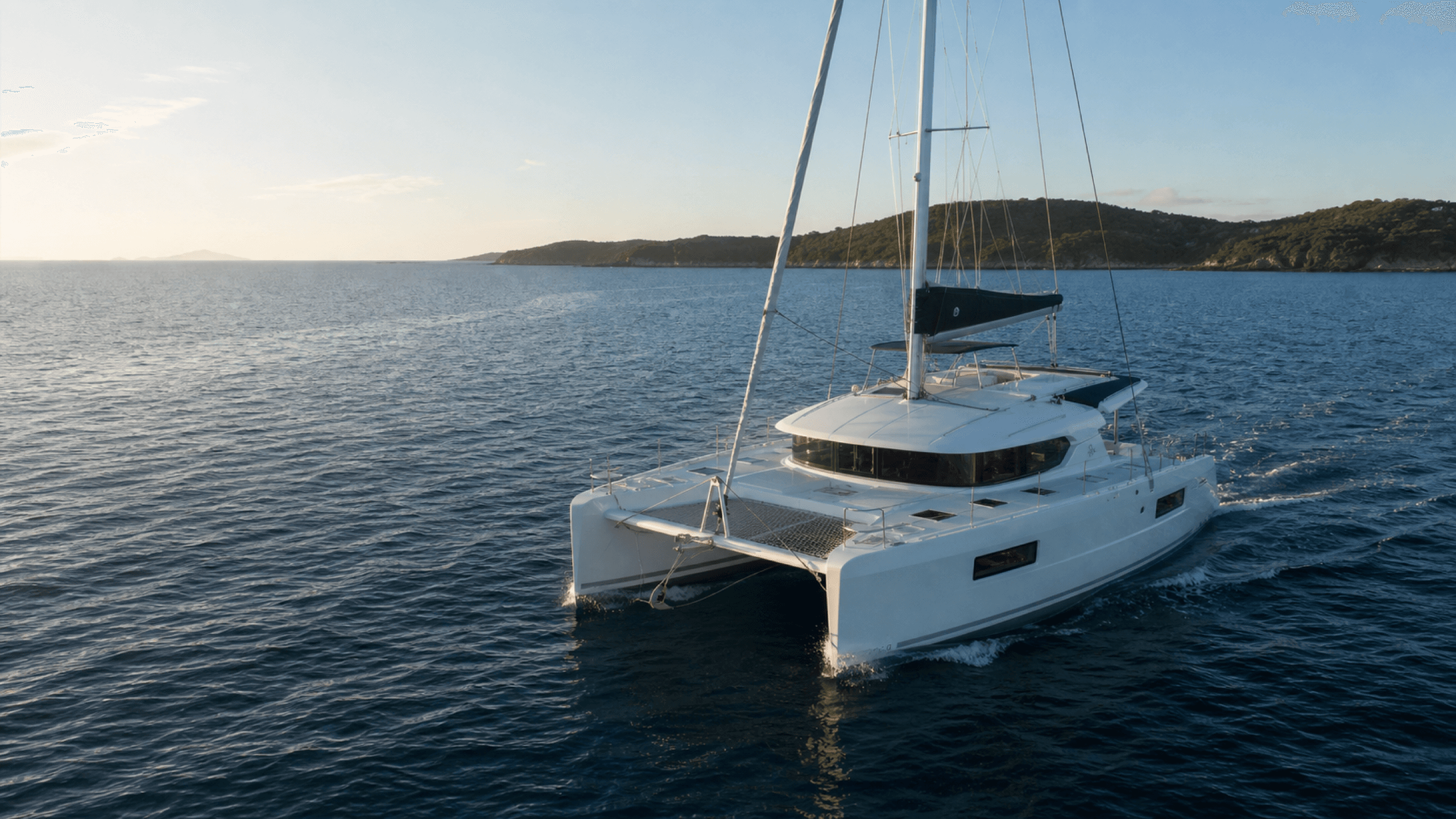
The current Lagoon 42 Millenium specifications list a 42-foot hull length, an overall length of 43 feet 4 inches with all options, and a beam of 25 feet 2 inches. Those proportions create an extraordinary amount of usable space compared with a similar-length monohull, yet the boat remains within a size range that an experienced couple can realistically manage. Its shallow draft of roughly 4 feet 2 inches also expands the cruising grounds available to owners. ()
This is an important sweet spot. A smaller catamaran may require sharper compromises in payload, cabin dimensions, machinery access, and cockpit space. Move much larger, and purchase costs, marina availability, sail loads, and maintenance demands rise quickly. The Lagoon 42 feels substantial without automatically requiring a professional crew.
The beam deserves particular attention when planning ownership. It delivers the stability and living space that make the boat so appealing, but it also affects haulout options and slip availability. Owners who cannot secure suitably wide slips may rely more heavily on moorings or anchorages. In warm-water cruising regions, that can be part of the attraction rather than a disadvantage.
Living Space That Works Underway and at Anchor
The Lagoon 42’s greatest achievement may be the way its interior and exterior areas connect. Wide stern platforms provide a welcoming route aboard from a dock, tender, or swim. Only two low steps lead into the cockpit, and the cockpit and saloon share a nearly continuous level. This makes circulation easy while carrying provisions, serving meals, or simply moving around with children and guests. ()
The cockpit is not merely an outdoor seating area attached to the back of the boat. It functions as the center of daily life. There is room to dine, relax, watch the anchorage, and remain connected with whoever is cooking in the galley. The solid overhead structure provides valuable shade and weather protection, while the open stern maintains ventilation and a direct connection to the water.
Inside, wraparound glazing gives the saloon excellent outward visibility. The galley-up arrangement keeps food preparation near both the saloon table and cockpit, so the cook does not disappear into a hull. Lagoon also retained a dedicated navigation station, a useful feature for route planning, monitoring systems, or working aboard. Nauta Design’s interior favors light colors, rounded forms, and practical circulation rather than visual drama at the expense of function.
A Helm Designed for Real Crews
The raised port helm is one of the Lagoon 42’s defining features. It offers access from the cockpit and side deck without isolating the person steering on a full flybridge. Two people can sit at the helm, and another crewmember can move nearby without bringing cockpit traffic directly through the working area.
Most primary sail controls lead back to the helm station. The self-tacking jib removes a major task from every tack, while closely grouped winches, clutches, engine controls, and instruments support short-handed operation. Independent reviewers have repeatedly highlighted the simplicity of getting the boat sailing and the relative ease of trimming from this centralized position. ()
No helm arrangement is perfect. Visibility should be evaluated personally, especially when docking, because sightlines depend on the helmsperson’s height, cockpit enclosure, tender position, and installed equipment. A competent crew should also maintain communication between the helm and the opposite stern quarter. Twin engines provide excellent low-speed maneuvering once the skipper understands how to use differential thrust.
A Sail Plan With Cruising Priorities
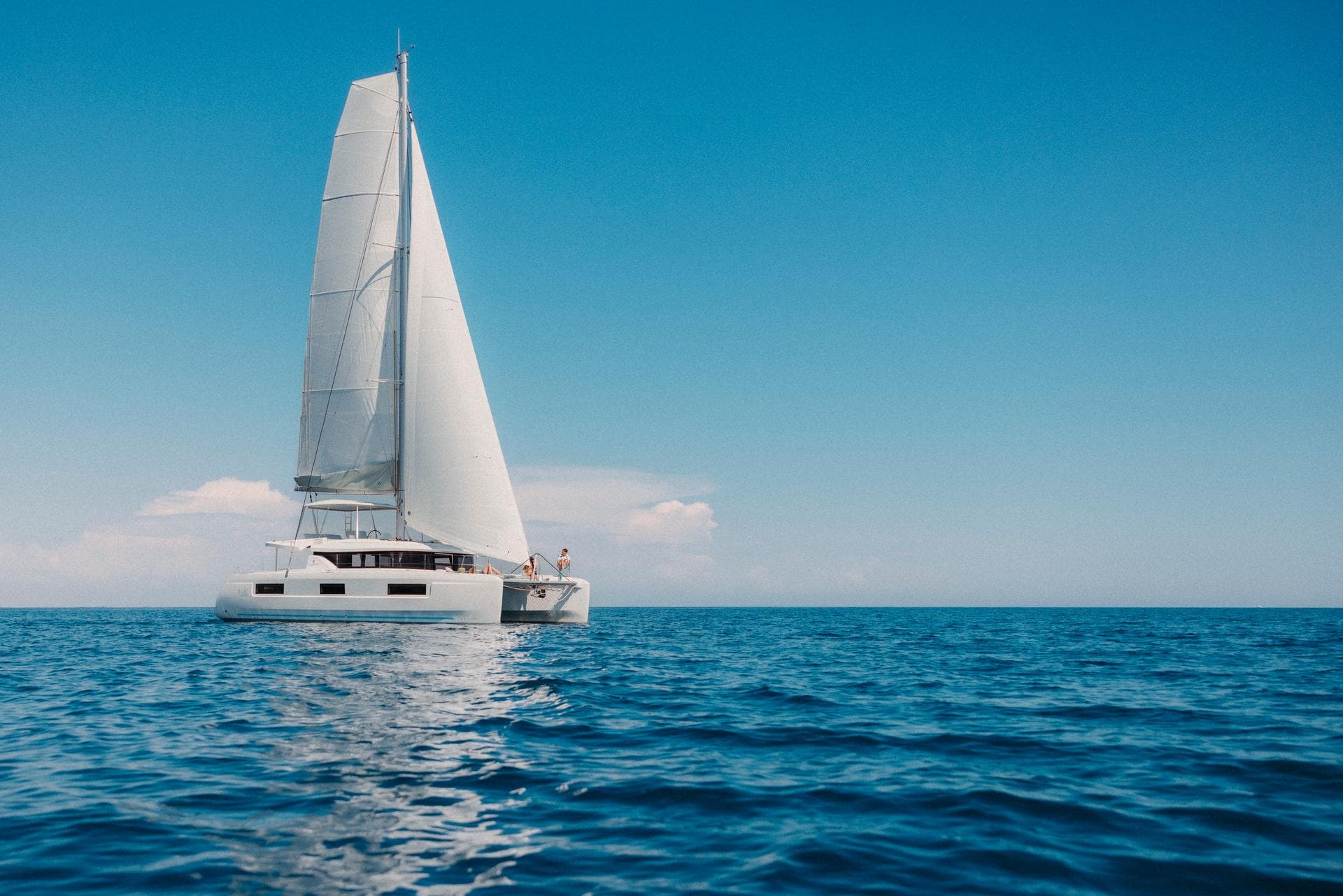
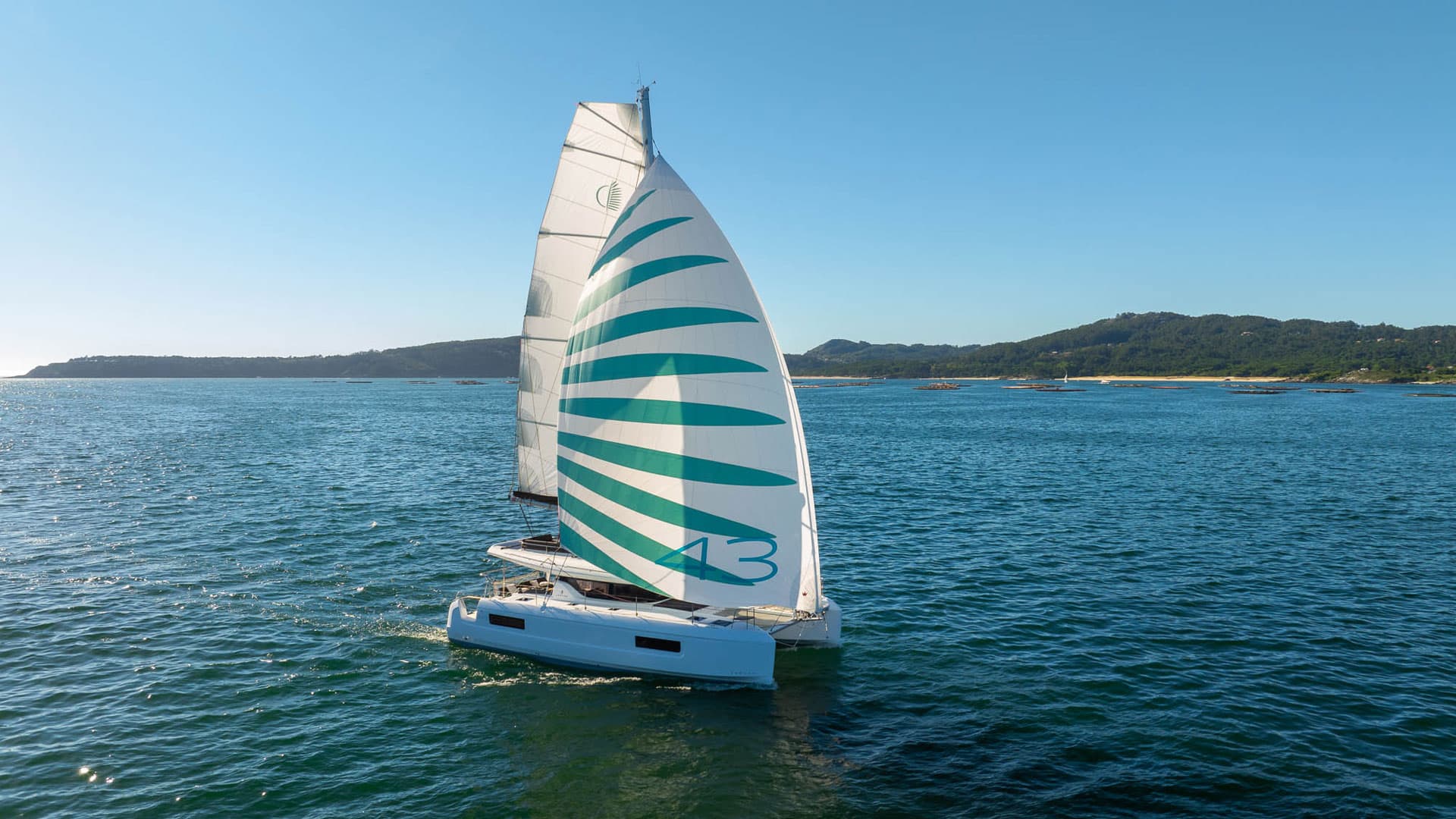
Lagoon positioned the mast farther aft than on many earlier cruising cats. This creates a larger foretriangle, reduces boom length, and supports a high-aspect mainsail with a self-tacking jib. The arrangement simplifies routine sailing while leaving space for a Code 0 or other reaching sail. VPLP and contemporary reviewers also identified weight centralization and reduced pitching as goals of the rig configuration. ()
With the main and self-tacker, the Lagoon 42 is straightforward to sail. Add a Code 0, and its useful wind range expands considerably in light conditions and on reaches. That sail can make a meaningful difference for cruisers who would rather keep moving quietly than start the engines whenever the breeze softens.
The Lagoon 42 should still be understood for what it is: a comfortable production cruising catamaran with a listed EEC light displacement of about 26,700 pounds, not a lightweight performance machine. It generally rewards sailing slightly free of the wind rather than pinching hard to weather. Tests have recorded respectable speeds in light and moderate air, smooth tacking, and stronger performance on a reach. Those results are encouraging, but owners should not treat isolated test figures as guaranteed passage averages. ()
Comfort Without a Single Fixed Formula
The Lagoon 42 generation introduced in 2016 was offered in three-cabin and four-cabin configurations. The three-cabin owner’s version dedicates an entire hull to a private suite, typically including a large berth, desk or seating area, storage, and a spacious head. For a cruising couple who regularly hosts friends, this arrangement delivers privacy that is difficult to match on a monohull of comparable length.
The four-cabin version provides greater sleeping capacity and is particularly well suited to charter groups, larger families, or owners who frequently cruise with guests. The current Lagoon 42 Millenium is presented as a four-cabin edition, and Lagoon lists six to 12 berths. Buyers should assess how many people will actually live aboard rather than being seduced by the maximum berth count. ()
A Strong Platform for Cruising Life
At anchor, the Lagoon 42’s appeal becomes obvious. The stable platform, sheltered cockpit, broad saloon, separate cabins, and easy water access turn a scenic stop into a comfortable home. The large aft area also supports the routines that define cruising: loading a tender, rinsing snorkeling equipment, handling groceries, drying towels, or gathering everyone for dinner.
That comfort has to be protected through disciplined loading. Cruising equipment, spare parts, solar installations, watermakers, tools, provisions, and personal belongings accumulate rapidly. Excess weight affects bridge-deck clearance, motion, sailing performance, and fuel consumption. A thoughtful Lagoon 42 owner treats payload as a limited resource, even when the boat appears to offer room for everything.
The Benefit of a Proven Population
A fleet exceeding 1,000 boats creates practical advantages. Prospective buyers can find examples in private use and charter fleets, compare multiple model years, and learn from a substantial owner community. Surveyors, service yards, sailmakers, and equipment specialists are also more likely to have encountered the model than they would a low-volume catamaran.
A large population does not eliminate the need for careful inspection. Equipment packages and tank capacities changed during the production run, while maintenance standards vary considerably between individual boats. Buyers should verify the specifications of the exact hull under consideration and commission a thorough survey, including rig, engines, saildrives, steering, electrical systems, moisture, deck hardware, and evidence of grounding or charter-related wear.
Why the Lagoon 42 Still Makes Sense
The Lagoon 42 is amazing not because it dominates every measurement, but because its compromises align closely with real cruising. It offers enough performance to make sailing rewarding, enough volume to make extended time aboard comfortable, and a deck plan that does not demand a large crew for ordinary operation.
Performance-focused sailors may prefer a lighter catamaran with daggerboards, while buyers prioritizing maximum tankage or workshop space may look elsewhere. For families, charter crews, and couples seeking a proven cruising catamaran, however, the Lagoon 42 remains exceptionally persuasive. Its enduring success comes from making life aboard easier without removing the fundamental pleasure of traveling under sail.