Cure 68GT
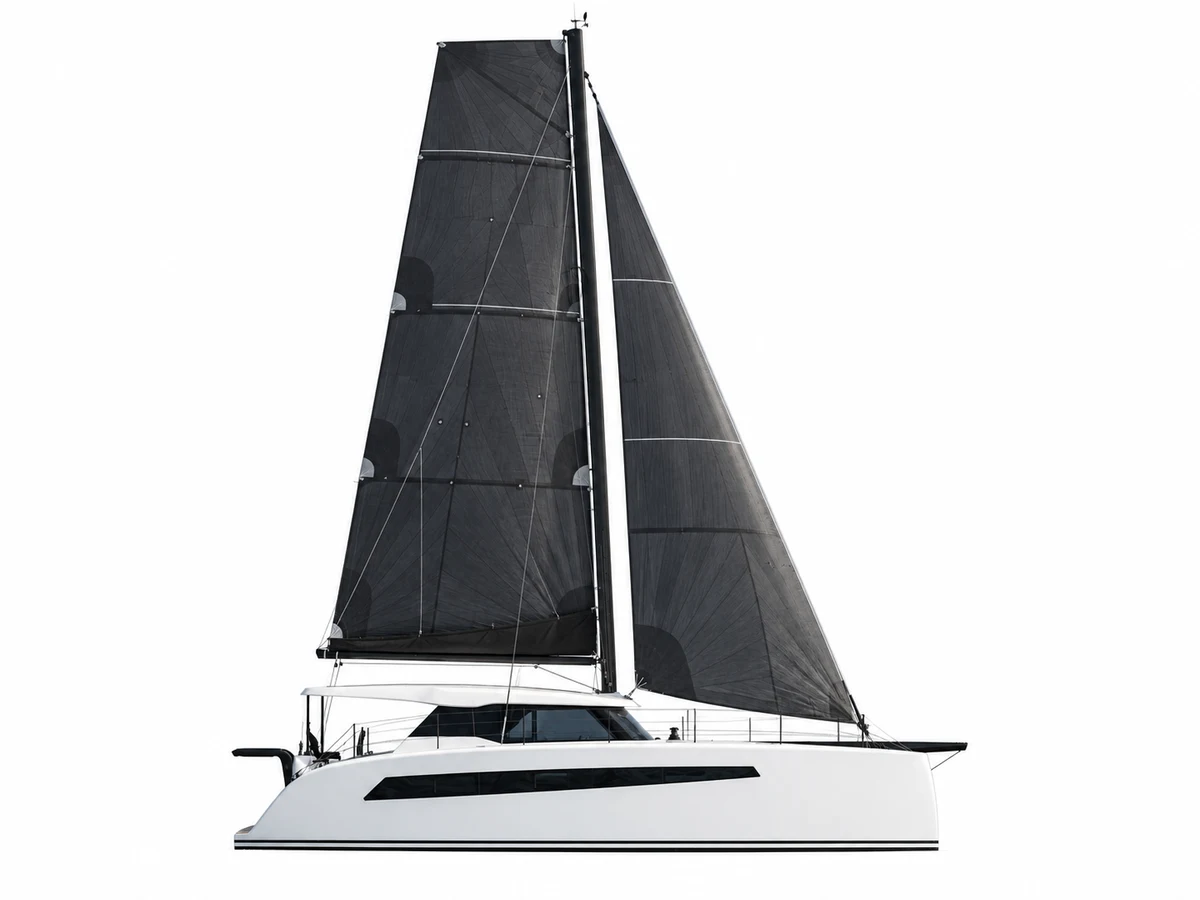
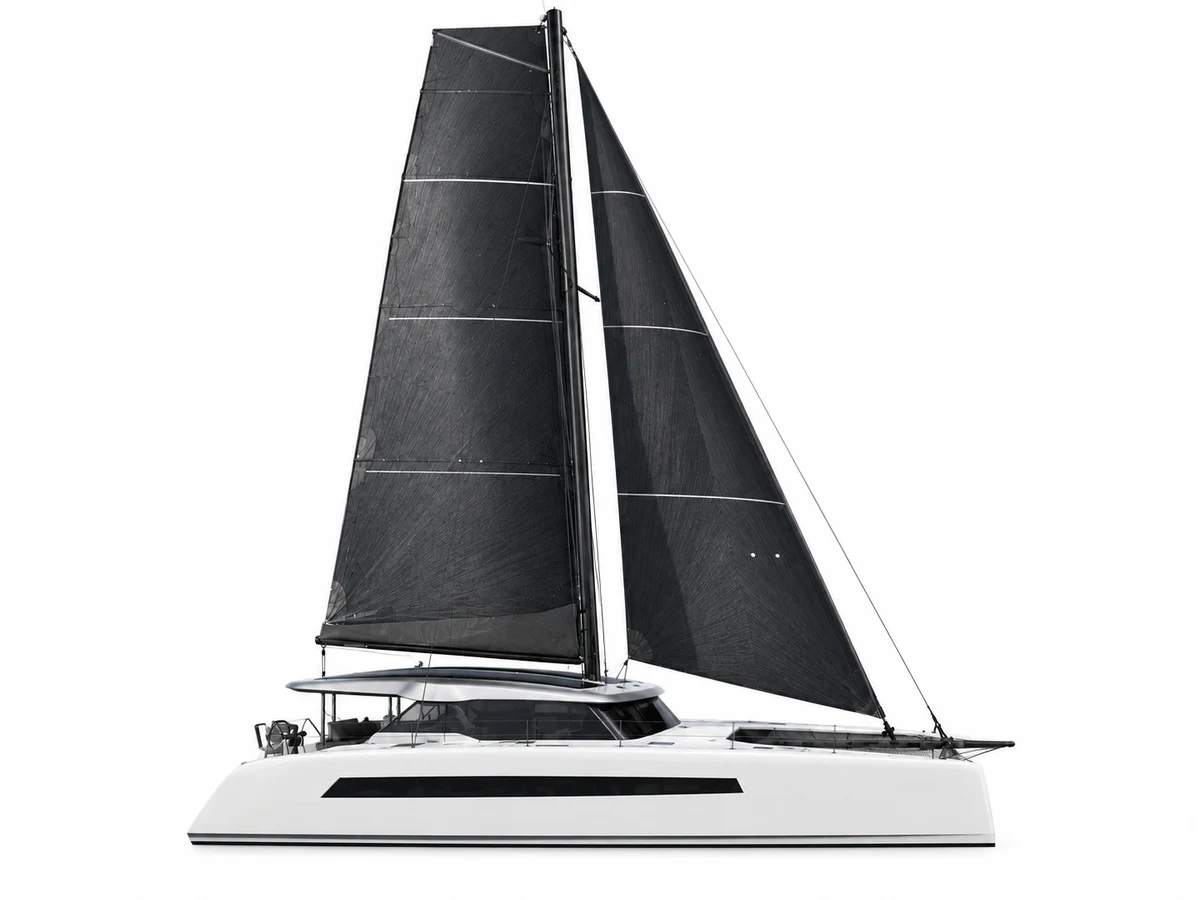
Manufacturer design renderings illustrate the exterior and interior arrangements. Images: Cure Marine.
About the Cure 68GT
The Cure 68GT is a full-carbon sailing catamaran designed by Bury Design and built by McConaghy in Zhuhai, China. As the largest stated model in the Cure range, it has an LOA of 21.63 m including the bowsprit, together with published saloon and lower accommodation arrangements. That format supports buyers planning around owner use, guests or crew rather than accepting one prescribed cabin plan.
Accommodation is offered in multiple configurations, so cabin count should be matched to sleeping needs and how shared spaces will be used. Published drawings can help compare guest privacy, storage and service access, but they are design renderings rather than evidence of one universal fit-out. On CatamaranWorld, buyers can compare these arrangements with any actual Cure 68GT inventory listed before treating a particular plan as definitive.
The published sailing package pairs a carbon mast with dual articulating helms and 242 m² of combined mainsail-and-jib area. The helm arrangement matters when deciding how steering and nearby deck work will be organised. Auxiliary power comes from two 80 hp Yanmar diesels, while the published hotel specification combines solar, a lithium battery and a full electric galley for buyers to assess against expected electrical use.
Compared with the Cure 55GT and Cure 48GT, the 68GT has greater published length, beam and mainsail-and-jib area. The 55GT offers named three- or four-cabin arrangements, while the 48GT drawings include a three-cabin plan; the 68GT is described more broadly as having multiple configurations. Buyers should favour the 68GT when its larger platform and selected arrangement justify the berth implications, or shortlist the smaller models when a defined cabin plan is the stronger priority.
Cure 68GT accommodation layouts
Manufacturer general-arrangement drawings. Open a plan for a closer look.
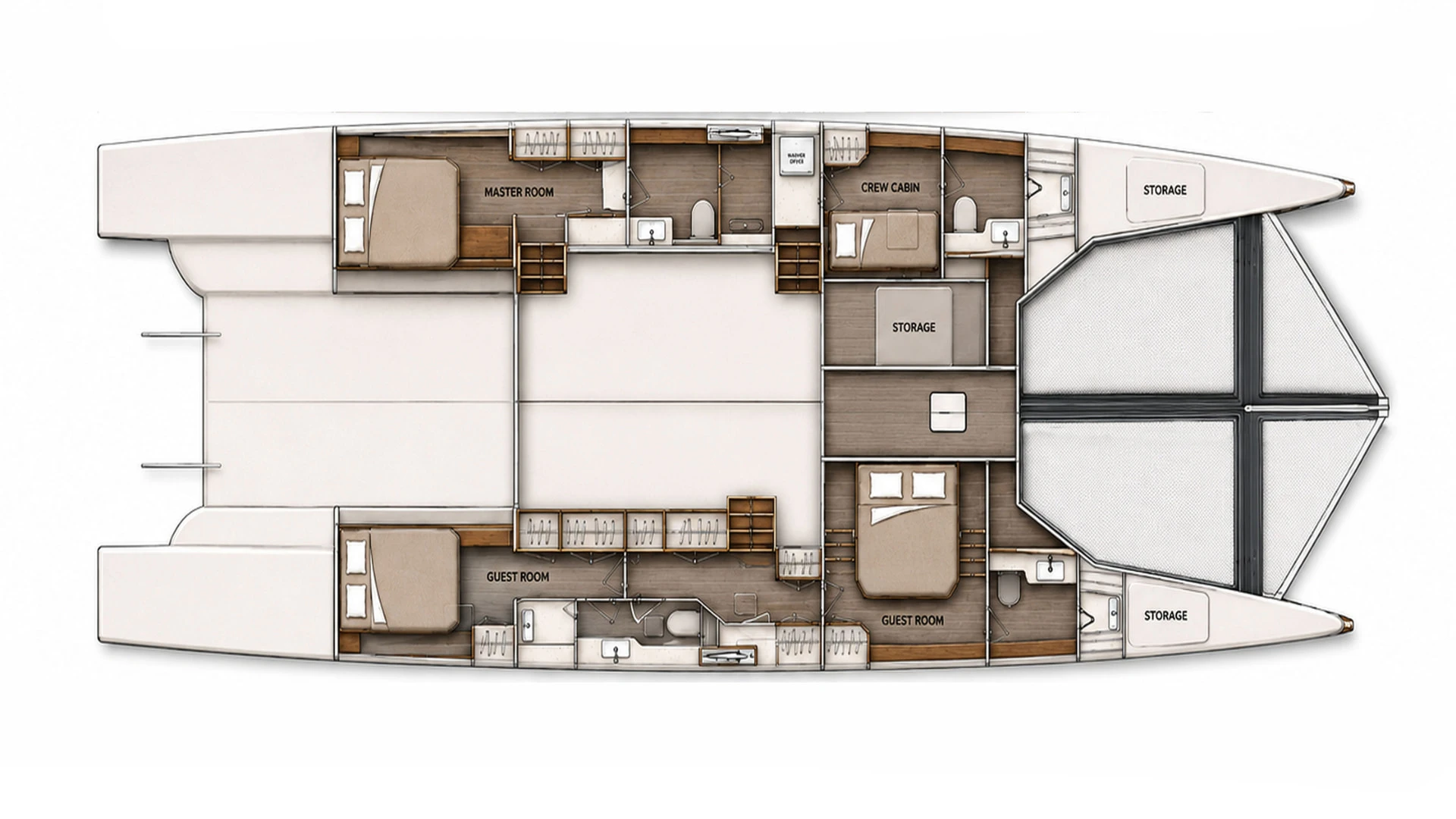
Published lower-deck accommodation arrangement, showing cabins and heads.
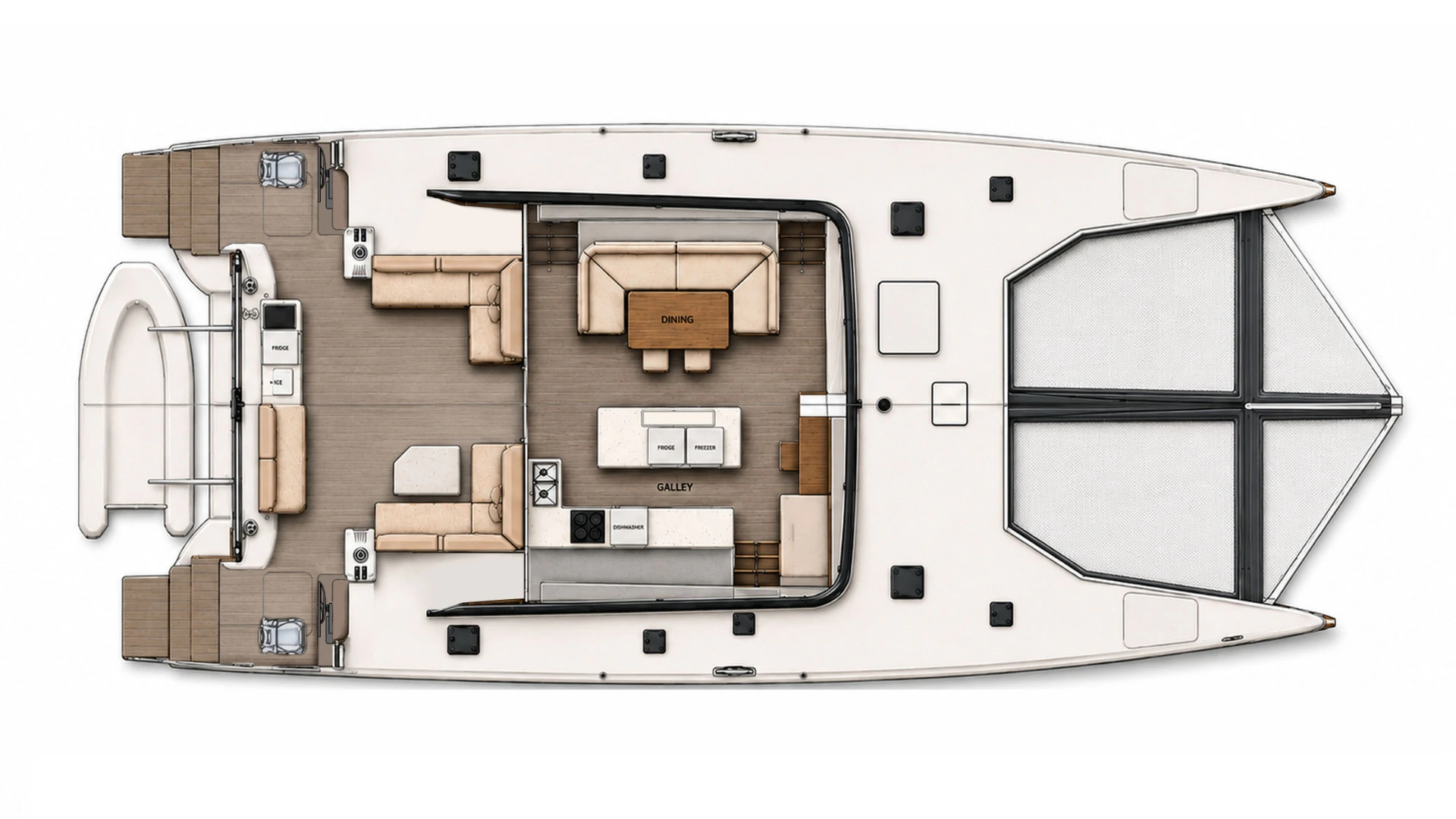
Published main-deck arrangement showing the cockpit, saloon and galley.
Testimonials
“Carbon from mast to rudder”
Katamarans calls the full-carbon 68GT Cure’s flagship, aimed at long-range cruising. Carbon daggerboards, rudders, mast, longeron and crossbeam are standard.
Katamarans lists 242 m² of main-and-jib area, a 50 kWh battery and 3.8 kW solar. Its calculated lightship sail-area-to-displacement ratio, 35.2, leads the three models on specifications, not sailing results.
“Helm controls within easy reach”
In its 68GT model overview, Cure Marine describes twin articulating helm stations designed to provide visibility and access to sail controls. The manufacturer says integrated carbon helm seats put navigation and propulsion controls within reach, with line runs and deck access planned for movement around the boat.
Cure Marine offers multiple accommodation configurations for family voyages or passages with guests and crew rather than prescribing one cabin plan. Its equipment list specifies a full-electric galley, 800 L of total fuel capacity and 800 L of total fresh-water capacity as part of its proposed long-range cruising package.
Model years & editions
Key milestones and configuration choices.
- Current design
Cure 68GT development
The manufacturer presents the 68GT as the larger design in its current range. Public performance data and the final sail plan remain subject to confirmation; the gallery is design imagery.
- Layouts and systems
Owner-specific arrangements
The larger platform offers multiple accommodation configurations. Guest and crew spaces must be established from the selected design.
Cure 68GT FAQs
Do the Cure 68GT renderings document a delivered yacht?
No. The imagery on this page illustrates the manufacturer’s design. The public specification and layout material describe the proposed configuration, not a delivery record or measured sea trial. Confirm the individual hull’s build status and delivery schedule when discussing a purchase.
Does every Cure 68GT have a fixed cabin arrangement?
The manufacturer offers multiple configurations for owners, guests and crew rather than a single universal cabin count. Agree the actual arrangement, including bathrooms, service routes and storage. A layout drawing is a design option, not proof that a particular boat has been built that way.
What is included in the Cure 68GT’s carbon construction claim?
The reference specification describes a full-carbon hull with carbon daggerboards, rudders, mast, longeron and crossbeam. That is more extensive than local carbon reinforcement in a glass-fibre structure. Confirm the contracted laminate and component schedule alongside the equipment and weight estimate.
What draft and beam does the Cure 68GT design specify?
The current model detail page gives a 9.27 m beam, with 1.40 m draft boards up and 2.60 m down. Overall length including the bowsprit is 21.63 m. Verify the final build dimensions for berths and haul-out facilities rather than relying on the rounded model number.
Is the Cure 68GT an electric-propulsion yacht because it has a 50 kWh battery?
No. The reference propulsion is twin 80 hp Yanmar diesels. The 50 kWh lithium bank and 3.8 kW solar array are electrical-system specifications, not evidence of electric drive motors. Assess propulsion and domestic energy separately using the final equipment list.
Can the current Cure 68GT polar diagram establish its passage speed?
No. The manufacturer explicitly marks the 68GT polar data as still to be confirmed and the displayed diagram as reference only. The sail plan is also subject to confirmation. Do not use that illustration as a measured speed claim or a guaranteed passage-time calculation.
Considering a Cure 68GT?
Talk through layouts, equipment, ownership costs and your cruising plans with a dedicated catamaran specialist.